![Bitcoin [News Pool]](https://dohodvseti24.ru/wp-content/uploads/2021/03/onlajn-novosti-o-bitkoine-logotip.png)

OKX analysts offer their views on the stages of development of blockchain technology from the emergence of Bitcoin to the development of cryptocurrency ecosystems.
Since the first practical use of blockchain, the capabilities of the technology have expanded significantly.. OKX Analysts turned to the main stages of blockchain development and that, how the use of technology has changed.
Stage one: Bitcoin and altcoins
The first practical application of blockchain occurred in 2009 year, when did bitcoin appear. The first Bitcoin block was mined by Satoshi Nakamoto - an anonymous developer or group of people, who published the Bitcoin White Paper a few weeks earlier. The White Paper describes the concept of creating a digital currency, which will be deprived of state control, its emissions will be transparent, and the authenticity of transactions is confirmed by mathematical calculations.
With the growing popularity of Bitcoin, other cryptocurrencies have emerged. Their developers tried to inherit the “success formula” of BTC and imitated it in every possible way. However, all projects at this stage only remained blockchains, who had their own coin - cryptocurrency. Developers, supporting the idea of Bitcoin, but do not agree with the community’s decisions on network development, created their own coins based on Bitcoin - forks. Litecoin is an example of one of the first successful altcoins, created based on a Bitcoin fork.
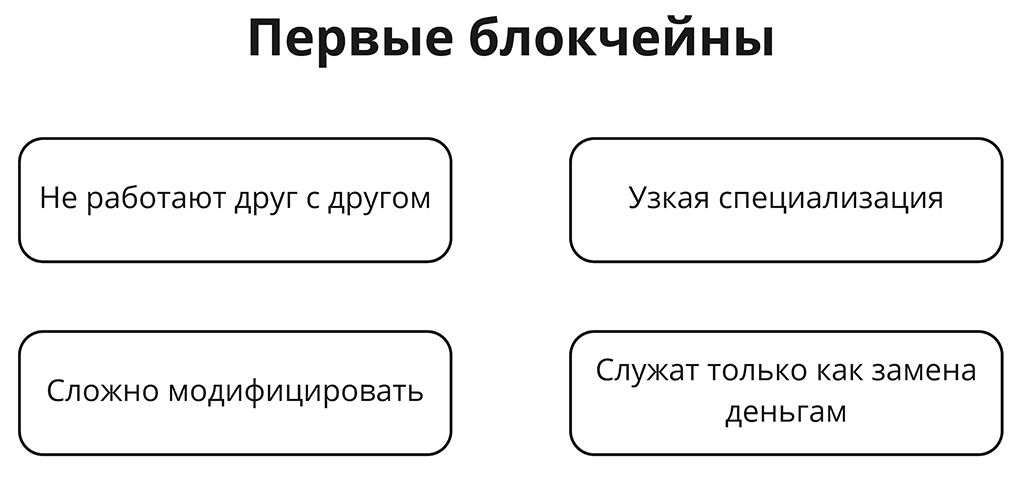
To 2015 years, the concept of replacing money dominated the basis of cryptocurrency projects. Altcoin developers tried to overtake Bitcoin in terms of speed, encryption algorithm or operating principle. Altcoins were either faster, or better encrypted, but essentially functioned only as a coin, which has a blockchain, and inherited SHA-like algorithms. Projects had added value, but remained highly specialized.
for instance, projects like Swiftcoin appeared, which differed from Bitcoin and other altcoins in the way they were mined. SwiftCoin could not be obtained through mining - the altcoin was distributed only after the loan was repaid in the Solidus Bond system.
Reasons for the popularity of the cryptocurrency concept
Crisis 2008 of the year. Due to the opacity of the real estate lending system and the questionable composition of sub-underlying assets, the real estate sector has become a huge financial bubble, the collapse of which led to one of the largest stock market declines in history.
Declining trust in fiat money. As a result of the crisis, many people stopped trusting governments and banks, which were supposed to protect them from financial collapse;
The concept of cryptocurrencies implies freedom from states. Completely anonymous, Cryptocurrencies that were not controlled by anyone and had value gave people a sense of freedom from the regime.
Stage two: transition period
One of the first attempts to expand the use of cryptocurrencies beyond the unit of account can be considered Synereo AMP - blockchain, which was supposed to become the world computer. However, another blockchain was destined to take this place. IN 2015 Vitalik Buterin launched a Turing-complete blockchain - Ethereum, which became the world's first distributed computer based on smart contracts.
The first stage of technology development was a time of discovery: people tried to understand the role of blockchain in the world. Cryptocurrency blockchains did not perform additional loads such as calculations - they all used or inherited the ideas of Bitcoin, and cryptocurrencies solved one specific problem and acted only as a unit of account.
Vitalik Buterin has developed a new blockchain-based distributed computing platform - Ethereum, which had script functionality, called smart contracts.
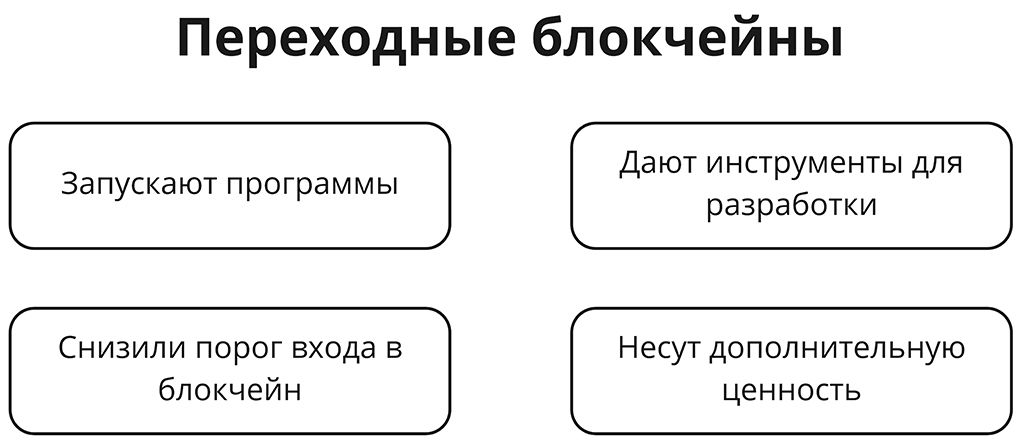
The emergence of smart contracts gave rise to the term “tokens”. With the advent of Ethereum smart contracts, it has become possible to create new tokens on top of the blockchain. At first these were simple tokens, which could only perform a monetary role. Later, smart contracts began to be seen as an opportunity to automate certain actions and create applications.
Because Ethereum is a Turing-complete blockchain, it became possible to develop any application on it. The idea of decentralized applications (dApp) was revolutionary, that it was now possible to perform calculations on the cryptocurrency blockchain, launch games and programs.
The transition stage is the time of birth of useful projects on the blockchain. С приходом Тьюринг-полной программной среды появилась возможность интегрировать блокчейн в любую сферу жизни. Прозрачность позволила превратить любой сложный процесс в открытую и отслеживаемую систему — некоторые страны стали внедрять блокчейн в государственные системы.
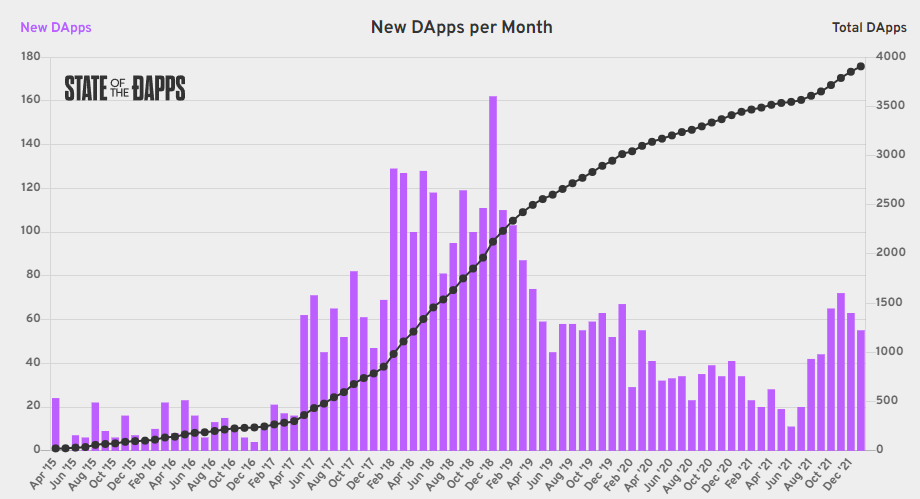
Пик популярности разработки dApps пришёлся на 2018 year, но всего за 2 года появилось более 140 applications.
Причины развития переходного этапа:
Блокчейны первых криптовалют не имели программную среду. Они выполняли заранее заложенные в них команды или задачи, но не обладали функциональностью смарт-контрактов — возможности первых блокчейнов ограничивались реализацией монетарных функций криптовалют.
Программируемые блокчейны были востребованы. К моменту появления смарт-контрактов разработчики протестировали различные варианты применения технологии: блокчейн для легализованной конопли, Stebblecoins, data storage, анонимность, шифрование от взлома. «Умные» блокчейны предлагали возможности реализовать различные практические подходы к применению технологии.
Блокчейн был дорогой идеей, платформы снижали порог входа. Разработчики первых криптовалют использовали уже устоявшуюся технологию, которую дорабатывали согласно потребностям. Разработка и запуск собственного блокчейна требовали много финансовых вложений.
Этап третий: экосистемы
Третий этап развития технологии продолжается и сегодня. Появление «платформовых» блокчейнов, способных обеспечивать экосистему для работы криптовалют, было следующим логическим шагом в развитии технологии. Экосистемы востребованы и решают несколько важных проблем в криптовалютной экономике.
Ни одна криптовалюта не имеет центрального банка, который мог бы регулировать ее инфляцию. Криптовалютным системам недоставало резервных фондов, монетарной поддержки для криптоактивов, систем кредитования и реализации права владения.
Блокчейны-платформы создали среду для поддержания работы криптовалют. for instance, появились проекты децентрализованных финансов (DeFi), которые принесли недостающую часть банковской системы в мир криптовалют — фонды ликвидности. Концепция NFT позволила реализовать право владения внутри экосистемы блокчейнов, благодаря чему смогла развиваться криптовалютная коммерция.
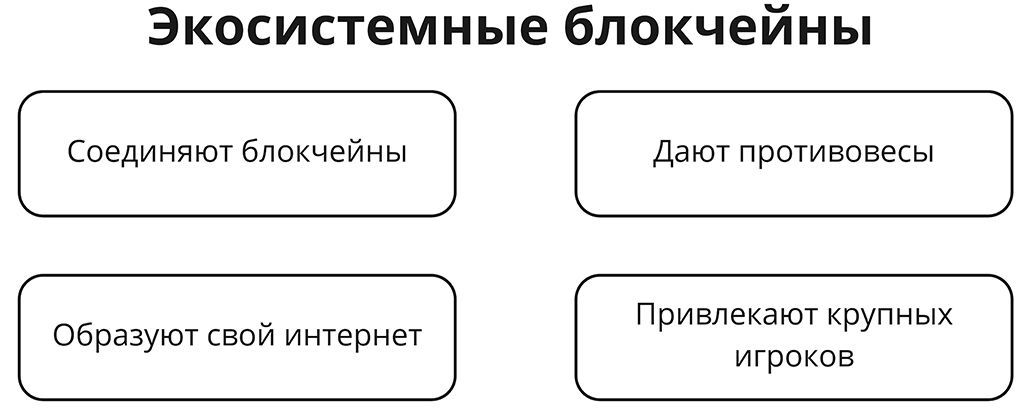
С появлением «платформенных» блокчейнов стало возможно налаживание связи между сетями: появились «мосты» — специальные смарт-контракты, которые автоматически и без участия человека обменивают криптоактив одного блокчейна на его эквивалент в другом блокчейне. Появление этих технологий в будущем позволит объединить все блокчейны в одну связанную экосистему.
Причины популярности экосистем:
Объединение блокчейнов. Для полноценной работы и реализации идей, заложенных Сатоши Накамото, криптовалютам не хватало своей экосистемы. У фиатных денег она была, криптовалюты получили её только с приходом экосистемных блокчейнов;
Запрос на стабильность. For, чтобы криптовалюты заинтересовали кого-то, кроме энтузиастов, они должны были предлагать финансовые противовесы. С появлением «платформенных» блокчейнов стали появляться корпоративные приложения и решения на базе блокчейна.
Вложить в будущее экосистемных блокчейнов можно уже сегодня и на OKX: через стейкинг в ETH 2.0. Для стейкинга через OKX необязательно блокировать 32 ETH — иметь право голоса в будущем сети позволит и 0.1 ETH. Присоединяйтесь к стейкингу на OKX:
https://www.okx.com/ru/earn/eth2/home