![Bitcoin [News Pool]](https://dohodvseti24.ru/wp-content/uploads/2021/03/onlajn-novosti-o-bitkoine-logotip.png)

Information service Walletexplorer.com, Indirectly Driven Chainalysis, reported to US law enforcement agencies data about site users.
The anonymity of cryptocurrency transactions, declared at the dawn of the "cryptocurrency era", has long been conditional. And the point is not in the principles of the system, and the willingness of part of the crypto community to share data with regulators and supervisory authorities. To some extent, the position is justified by commercial interests. But rather, it is caused not only by the desire to survive in a competitive environment, but also receive government preferences.
Chainalysis - secret intelligence agent
About that, that the analytics company Chainalysis is collaborating
with regulators and law enforcement agencies, providing personalized data of crypto asset holders, not news to the community.
The company openly states this on its
site:
"We provide data, software, services and research to government agencies, exchanges, financial institutions, insurance companies and companies, those involved in cybersecurity... to solve cybercrimes".
However, earlier this week CoinDesk received
materials, revealing another facet of Chainalysis’s cooperation with the criminal police. CoinDesk gained access to documents from Chainalysis's undated presentation to Italian police after they were published on DarkLeaks, a website, which allows you to buy and sell classified materials on the Internet for cryptocurrencies. The materials allow us to conclude, that Chainalysis secretly owns and administers walletexplorer.com.
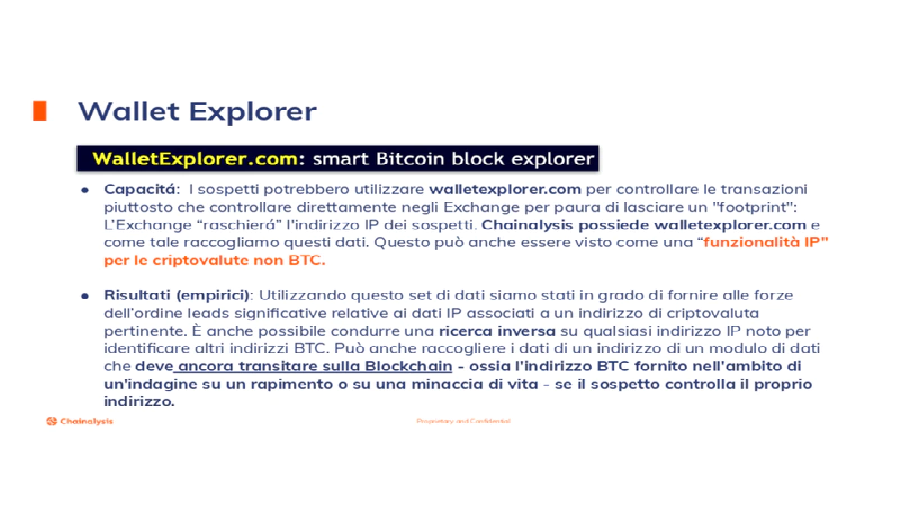
Like other blockchain explorers, the service provides users with the transaction history of public cryptocurrency addresses, with grouping by addresses and marking of wallets. According to Chainalysis presentation, suspected criminals can use the site to check the progress of transactions, Assuming, that they will not leave a digital trace, how to use cryptocurrency exchange services.
As a result, Chainalysis receives information about the IP addresses of the suspects and the addresses of cryptocurrency wallets relevant to them.. It is also possible to reversely match the IP address to the cryptocurrency wallet address. The company claims, that the service allows you to search not only for transactions with BTC, but also for any cryptocurrency, including XMR.
"Out of business, which Chainalysis worked on in collaboration with law enforcement agencies, we were able to provide useful information in approximately 65% cases ", – says in the Chainalysis presentation.
Chainalysis gave the example of June 2020 of the year, when walletexplorer.com identified the IP address of a ransomware suspect a few hours after, how he was suspected of depositing cryptocurrencies on the over-the-counter trading platform of the Huobi exchange.
From the presentation it became known, that in addition to this, the service records user data, using wallets with simplified verification (SPV). To this end, Chainalysis is launching a series of controlled full nodes on the Bitcoin network. If a light wallet user connects to one of these nodes, the company receives information about the user's IP address, full set of addresses in the wallet, wallet software type and version and other service information. What other platforms for collecting personal information are managed by Chainalysis, Unknown.
SushiSwap Launchpad Miso – return of stolen cryptocurrency for a bowl of soup
About that, that transactions on the blockchain do not remain outside the control of interested parties, confirms last week’s event - the hacking of the MISO platform of the decentralized exchange SushiSwap on $2.9 million and return of stolen tokens.
An attacker, officially called "anonymous hacker", introduced malicious code into the external interface of the platform and replaced the auction wallet address with his own addresses. Since it turned out, what wallets, used in the exploit, were linked to the wallet addresses of the cryptocurrency exchanges FTX and Binance, the SushiSwap team requested assistance in providing information about the hacker’s KYC.
After identification, the SushiSwap team contacted him personally demanding the return of the stolen money. Knowing the hacker's residential address, he was ordered home delivery of food - miso soup - as a psychological attack in anticipation of the negotiations.
"We thought, what is the best way to achieve the desired result – scare this guy and just make him send the money back", – said
one of the developers of the MISO platform. The idea worked.
Two icing on the cake: Coibase and OpenSea
At the end of the topic about disclosing the facts of obtaining personal data about the owners of cryptocurrency instruments, Let's give two more illustrative examples: Coibase and OpenSea.
Cryptocurrency exchange Coibase follows the path, off the beaten track Chainalysis, and successfully shares user data with government agencies at various levels. The exchange has developed a special analytical tool Coinbase Analytics, which is in demand by the Secret Service, Department of Homeland Security and Internal Revenue Service
US service. Despite constant criticism from the crypto community, Coibase is not going to stop mutually beneficial cooperation with the state, giving it access to budget funding.
In the case of OpenSea, top manager of the company Nate Chastain (Nate Chastain) suspected
in conducting trading operations using insider information, the investigation process was initiated and carried out by OpenSea community enthusiasts. Nate Chastain's cryptocurrency wallet address has been de-anonymized, and the operations are compared
with the addresses of the involved wallets. In the end, the suspicion was confirmed, and Nate Chastain was fired from the company.
Non-anonymous transparency
When performing transactions with crypto assets, some users naively believe, that they are joining a community independent of government regulation, which respects the principles of decentralization and confidentiality. However, in reality this is not entirely true..
Benefits of Blockchain Technology, immutability and transparency of the block chain, became the basis for the creation of tools for monitoring events in the crypto space by the state, justice authorities and, perhaps, other interested parties. Like any “weapon of retaliation”, the vector of its application and consequences depend on the goal being pursued.